
What Does a Listing Agent See When They Read Your Buyer's Pre-Approval?
Your buyer is 'pre-approved.'
You write the offer. It goes in strong. The listing agent reviews it, picks up the phone, and calls the lender on the letter.
What happens in that phone call, and what that lender says, can decide whether your client gets the house.
Most agents treat the pre-approval letter as a checkbox. Get it, attach it, move on. But not all pre-approvals are the same. Not even close. The difference between a strong pre-approval and a weak one can mean the difference between accepted and rejected in a competitive situation.
Here's what agents need to know.
There Are Actually Three Levels. Most Agents Only Know Two.
Everyone knows the first two. Pre-qualification and pre-approval. What most agents don't know — and most lenders don't offer — is the third level. The one that actually moves sellers.
Level 1: Pre-Qualification
This one is essentially worthless in a competitive offer situation.
A pre-qualification is based entirely on what the client tells the lender. No credit pull. No income verification. No documentation review. As the CFPB explains, these letters are informal estimates — not conditional approvals. The lender takes the client's word for it, runs rough math, and issues a letter that says 'this person might be able to borrow X.'
It takes about five minutes online. Anyone can get one.
When a listing agent sees a pre-qualification letter on an offer, here's what they actually hear: 'This buyer talked to someone once.' No verification. No commitment. No real signal about whether this deal will close.
The Agent Reality:
In a multiple-offer situation, a pre-qualification letter is a liability. It signals to the listing agent that the buyer's financing hasn't been seriously vetted. In a competitive market, leading with a pre-qual is leading with your weakest card.
Level 2: Standard Pre-Approval
This is the industry standard. Better, but it still has limits.
A standard pre-approval involves a hard credit pull, income documentation (W-2s, pay stubs, sometimes tax returns), and a review of the client's debt-to-income ratio. According to Zillow, pre-approval letters are typically valid for 45 to 90 days depending on the lender so timing matters.
The key word here: loan officer.
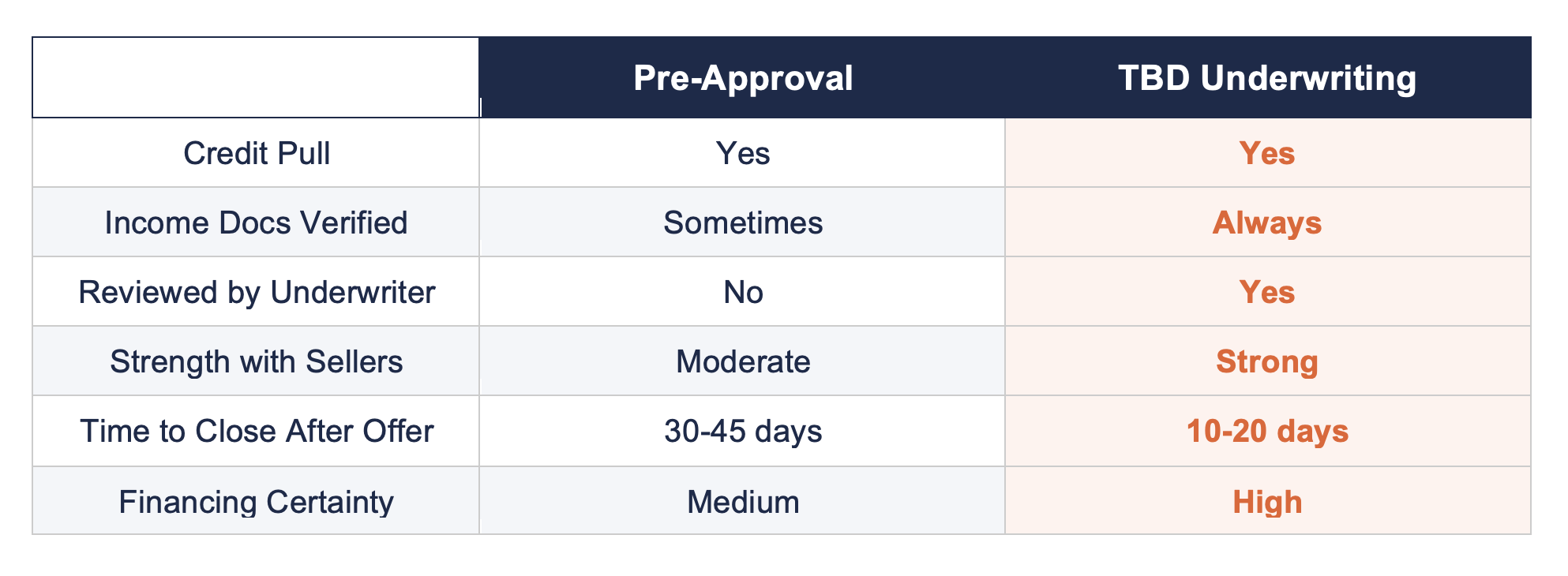
The file hasn't been to underwriting. An actual underwriter hasn't reviewed it. The pre-approval is based on the loan officer's read of the file, which is usually accurate but not guaranteed. Things get flagged in underwriting all the time that didn't surface at pre-approval.
Self-employment income that doesn't calculate the way the LO thought. A credit issue that wasn't visible until the full file went through. A DTI that looked fine on the surface but tightened once the actual mortgage payment was factored in.
For a full picture of what trips up first-time buyers at this stage, see The Pre-Approval Mistakes No One Warns Buyers About on the Dwell blog.
Standard pre-approval is required and respected. But in a tight multiple-offer situation, it doesn't give a listing agent certainty.
Level 3: TBD Underwriting (The Real Weapon)
This is what separates agents who consistently win offers from the ones who keep finishing second.
A TBD (To Be Determined) underwritten approval means the client's entire file — income, assets, credit, employment, documentation — has been reviewed and conditionally approved by an actual underwriter before they've even found a home.
The only thing missing from a TBD approval is the property address. Everything else is done.
When the offer goes in with a TBD underwritten approval letter, a listing agent isn't wondering if the financing will hold. They're not calling the lender to ask vague questions. They know the underwriter has already signed off on the buyer. The only remaining step is the appraisal.
That changes the conversation completely.
What TBD Underwriting Means in Practice:
● Closing timelines can compress to 10-20 days (vs. 30-45 for standard financing)
● Financing contingency can sometimes be waived or shortened
● Listing agents and sellers treat the offer with near-cash confidence
● The buyer avoids the most common underwriting surprises — because those are already resolved
At a Glance: How the Three Levels Compare
What a Listing Agent Actually Does With That Letter
Here's the part nobody talks about.
When your offer hits the listing agent's desk, they do three things with the pre-approval letter. They read it. They Google the lender. And they call.
That phone call is critical. What the lender says tells the listing agent everything about how this deal is going to go.
A listing agent who gets a standard pre-approval from a lender they've never heard of is already skeptical. They're thinking about the last deal that fell apart in week three. They're asking themselves: is this real?
A listing agent who gets a TBD underwritten approval from a known broker who picks up on the first ring and says 'the underwriter has already reviewed the file, we just need the property address' — that agent relaxes. That seller gets confidence. That offer moves to the top.
The Dwell Standard:
Every pre-approval we issue is built to survive underwriting. We pull credit, verify income and assets, review documentation, and calculate DTI against the actual purchase price. When a listing agent calls us on your buyer's offer, they get a real answer. Fast.
The 3 Questions Every Agent Should Ask Their Lender Before Submitting an Offer
Most agents never ask these. The ones who do protect their clients far more effectively.
1. 'Has an underwriter reviewed this file?' If the answer is no or the lender seems unsure, that pre-approval is a loan officer opinion. It may be accurate. It may not. Know the difference.
2. 'What's the weakest part of this file?' A good lender will tell you. They'll flag the self-employment income, the recent job change, the credit score right on the edge of the threshold. If a lender says 'it looks great, no issues' without being specific, push harder.
3. 'Can we get this fully underwritten before we write the offer?' In a competitive market, this question alone can change the outcome. Some lenders offer it. Most don't, because it requires actual work upfront. A broker with a real process can deliver this.
Why This Is an Agent Problem, Not Just a Buyer Problem
Here's the part that doesn't get said enough.When your buyer's financing falls apart in week three, you don't just lose the deal. You lose the relationship with the seller's agent. You potentially lose your client's goodwill. You burned hours on a transaction that went nowhere.
The pre-approval letter your buyer walks in with is a reflection of the lender you sent them to.
The listing agent who calls you about your buyer's offer and hears 'they're fully underwritten, the file is clean' — that agent is going to remember you. They'll suggest your buyers in future multiple-offer situations. They'll tell their sellers your clients are low-risk.
Your lender's credibility is your credibility.
The Bottom Line
Pre-qualification is noise. Don't attach it to a competitive offer.
Standard pre-approval is the floor. Required. Respected. Not a competitive advantage.
TBD underwriting is the ceiling. More work upfront. But it's the difference between an offer that wins and an offer that finishes second.
Your clients are working hard to find the right home. The lender you send them to either protects that effort or puts it at risk.
Know which kind of pre-approval your lender issues. Then decide if that's good enough. Also worth reading: How to Successfully Close on Your First Home and Ready to Buy Your First Home — two posts to share directly with your buyers.